


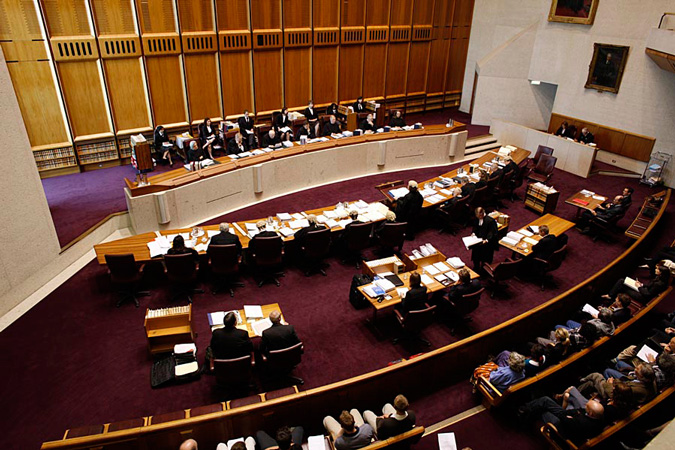
The High Court of Australia is able to deal with cases which come to it on appeal or which begin in the High Court itself.
Cases which involve interpretation of the Constitution, or where the Court may be invited to depart from one of its previous decisions, or where the Court considers the principle of law involved to be one of major public importance, are normally determined by a full bench comprising all seven Justices if they are available to sit.
Other cases which come to the High Court for final determination involve appeals against the decisions of the Supreme Courts of the States and Territories, of the Federal Court of Australia and of the Family Court of Australia and these are dealt with by a full court of not less than two Justices. In addition there are certain matters which can be heard and determined by a single Justice.
The subject matter of the cases heard by the Court traverses the whole range of Australian law. It includes, for instance, arbitration, contract, company law, copyright, courts-martial, criminal law and procedure, tax law, insurance, personal injury, property law, family law, trade practices, etc.
Most of the Court's work relates to the hearing of appeals against decisions of other courts. There is no automatic right to have an appeal heard by the High Court and parties who wish to appeal must persuade the Court in a preliminary hearing that there are special reasons to cause the appeal to be heard. Decisions of the High Court on appeals are final. There are no further appeals once a matter has been decided by the High Court, and the decision is binding on all other courts throughout Australia.
Rules of Court, which are made by the Justices, set out the procedural steps that legal practitioners must comply with in preparing a case for hearing, including the preparation of an Appeal Book. The Appeal Book prepared by the appellant's legal practitioner, contains basic documentation which is necessary background for the Court to consider the issue raised by the appeal.
During the hearing, barristers representing the parties present their arguments orally to the Court.
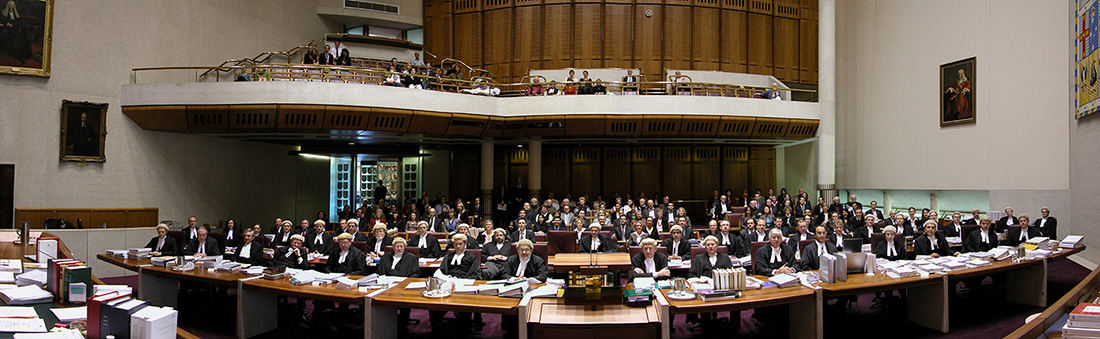
This picture was taken in Courtroom 1 of the High Court in Canberra at the beginning of the hearing of the Work Choices case (State of New South Wales v Commonwealth of Australia, State of Western Australia v Commonwealth of Australia, State of South Australia v Commonwealth of Australia, State of Queensland v Commonwealth of Australia, Australian Workers Union & Another v Commonwealth of Australia, Unions NSW & Others v Commonwealth of Australia, State of Victoria v Commonwealth of Australia) on Thursday, 4 May 2006. It is noteworthy in that it involved the most number of counsel (39) ever to appear before the High Court in a case.
The Court rarely gives its decision (i.e. the judgment) at the end of a hearing. Rather, the decision is "reserved" and presented some time after the hearing. Each Justice makes his/her own decision on cases, and where decisions are not unanimous, the decision of the majority prevails.
The usual practice is for Justices to prepare written reasons for their decisions which are handed down by the Court at a later sitting. Printed copies of the judgments are given to the parties involved immediately after the decision is announced by the Court. The decisions are subsequently recorded in law reports and are now also available on computerised legal data bases.
Paper copies of judgments are available to the public, for a fee, by contacting one of the offices of the High Court Registry in Canberra, Sydney or Melbourne. Electronic copies of judgments are available at the AustLII site and other sites free of charge.
Decisions of the High Court are binding on all other courts throughout Australia.