
Art short description
Commissioned for the opening in 1980, collection of the High Court of Australia
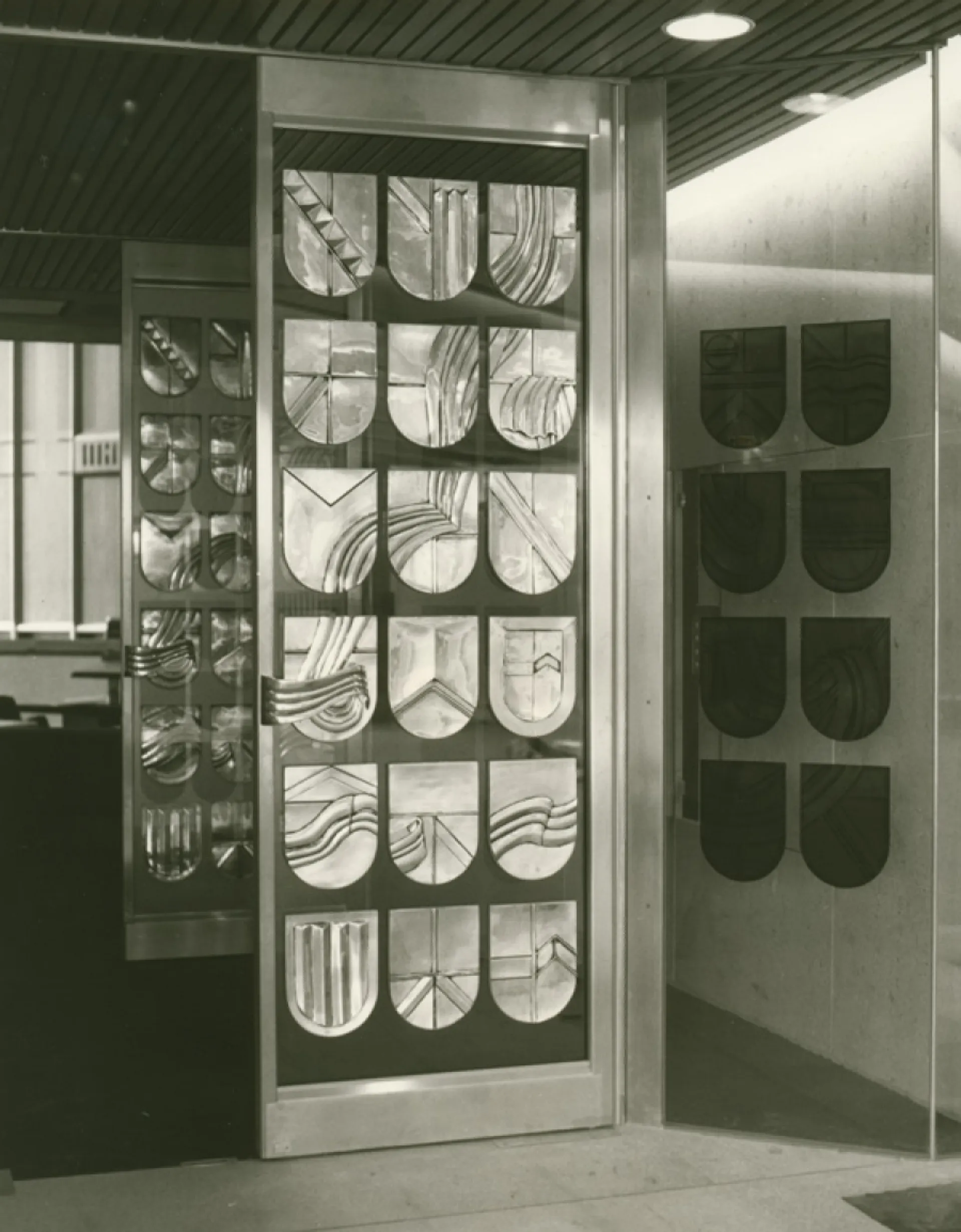
Commissioned for the opening in 1980, collection of the High Court of Australia
Each courtroom entry in the High Court building in Canberra comprises an air and sound lock with two sets of double doors and sidelights. The architecture is designed to convey a strong suggestion of privacy and hesitation before entering the solemnity, protocol and ceremony expected in courtrooms. The design theme across the courtroom doors is that of a grid formed by heraldic shields. The repetition and constant form of the shield imparts a sense of impartiality and universality as represented in the High Court. The shields represent the protection provided by the rule of law to the people. The forms and divisions within each shield are based on the combinations and variations found in the tradition of heraldry – here conveying the notion of Constitutional law as unfolding and capable of change as times change. The non-heraldic ribbon image unites the individual emblems, and represents the tapes used to bind legal documents, as well as the tabs used on legal dress – symbolising the qulity of binding, unifying and the flexibility of adjustment.
The late Les Kossatz was a well known Melbourne-based artist and academic whose work is represented in many regional and state galleries and the National Gallery of Australia. He studied art at the Melbourne Teachers’ College and the RMIT, and went on to teach at the RMIT and Monash University. Kossatz’s first significant commission was for the stained glass windows at the Monash University Chapel in Melbourne. Later commissions included works for the Australian War Memorial, the High Court, the Ian Potter Foundation at the National Gallery of Victoria and the Darling Harbour Authority, Sydney. His sculpture, 'Ainslie’s Sheep', commissioned by Arts ACT in 2000, is a popular national capital landmark in the centre of Civic. A major retrospective of Kossatz’s work was held in 2009 at the Heide Park and Art Gallery, Melbourne.